Cellulite: What It Is, Causes, Location & Treatment
Cellulite is a skin condition that many people notice at some point. The surface looks bumpy or dimpled, often compared to orange peel. It happens when fat cells underneath push against connective tissue. Those are the bands that connect skin to what lies beneath. When the push and pull are uneven, you see little pockets.
It’s not a disease. It doesn’t hurt or cause health problems. But people often look for ways to soften the texture because it changes how skin appears.
It’s also extremely common. Most women will see it at some stage, though men can get it too. Why one person has more than another depends on hormones, genes, and lifestyle.
Some turn to professional options. That includes treatments like Anti-Lipodystrophic Agents, which target fat distribution, or cosmetic choices such as blue and bold: buccal fat removal. Clinics also offer fat-dissolving products for professionals, showing how wide the market has become for appearance care.
What is Cellulite?
Cellulite is uneven skin caused by the way fat and connective tissue interact. The skin rests on fat, then muscle. Connective tissue bands pull the skin downward. Fat pushes upward. When the balance shifts, small dimples appear.
It doesn’t affect health. It only changes the look of the skin. That’s why doctors place it in the “cosmetic” category.
It can show up after puberty and often becomes more visible with age. Skin loses elasticity — the ability to stretch and spring back — which makes dimples stand out.
Causes of Cellulite
No single cause explains it. Several things overlap.
Structure: The main driver is fat pressing against connective tissue. Thin skin makes this more obvious.
Hormones: Estrogen plays a strong role in circulation and fat storage. When levels change during pregnancy or menopause, cellulite often appears. Other hormones, like insulin or thyroid hormones, may also affect fat distribution.
Genetics: Skin thickness, fat storage patterns, and blood flow are partly inherited. If your mother or grandmother had cellulite, chances are higher that you will too.
Lifestyle: What you eat, how much water you drink, and how active you are all matter. Processed foods and high salt can lead to water retention. Dehydration makes skin less plump. Sitting still for long hours slows blood flow. Smoking harms collagen, the protein that keeps skin firm, and that makes cellulite worse.
Common Locations of Cellulite
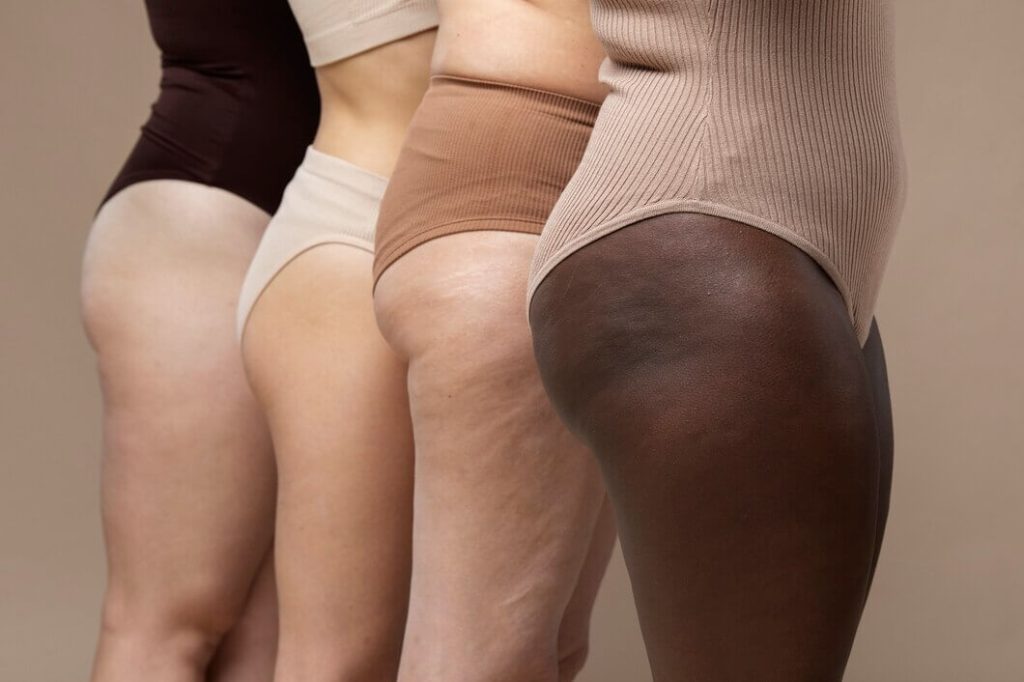
Cellulite can appear in many places, but some are more common than others.
Thighs and buttocks: These are the most frequent areas. They hold more body fat, and the connective tissue layout here makes dimples easier to form.
Abdomen: Pregnancy, weight change, or aging skin may bring cellulite to the stomach area. Even people at a healthy weight may notice ripples here.
Hips: Fat naturally gathers around the hips in women. This makes the area a frequent site for dimpling.
Arms and other spots: Some people develop cellulite on the upper arms, calves, or even breasts. This is less common but still possible.
Types of Cellulite
Doctors often classify cellulite by how visible it is.
- Grade 1 (Mild): Not visible when standing or lying down. You only see dimples if you pinch the skin.
- Grade 2 (Moderate): Dimples are visible when standing, but not always when lying down.
- Grade 3 (Severe): Dimples and uneven texture are visible both standing and lying down.
These grades are not about health risks. They simply describe how the skin looks. The severity depends on skin thickness, fat distribution, and age. Two people with the same body weight can have very different levels of visible cellulite.
Risk Factors for Cellulite
Some people are more likely to see it than others.
- Gender: Women develop cellulite more often. Their connective tissue bands are vertical, while men’s form a cross pattern that supports the skin better.
- Age: Skin thins and loses collagen with age. This makes dimples more obvious.
- Weight changes: Rapid loss or gain stretches or loosens the skin, so cellulite stands out more.
- Activity: Sitting too long slows circulation. Muscles weaken, and skin loses some support.
Treatment Options for Cellulite
There is no magic cure. Still, many ways can reduce how much it shows.
- Lifestyle approaches: Exercise builds muscle and keeps blood moving. Balanced meals rich in vegetables, fruits, and lean proteins feed skin cells. Drinking water daily supports plumpness.
- Non-surgical options: Creams with caffeine or retinol may tighten skin for a short time. Massage or rollers improve blood flow. Devices that use suction, vibration, or waves can make skin smoother for a while.
- Medical and aesthetic procedures: Clinics use laser therapy, radiofrequency, or injections to target fat or connective tissue. Results vary, and maintenance is usually needed.
- Expectations: The key is improvement, not total removal. Smoother, firmer skin is possible. Perfectly flat skin is not realistic.
Preventing or Reducing Cellulite Appearance

You can’t stop cellulite completely, and that’s worth saying upfront. Still, the way you live day to day has a big impact on how visible it looks. These habits are simple, but they add up when practiced over years, not just weeks.
Movement is at the top of the list. When you walk, stretch, cycle, or do anything that gets your heart rate up, circulation improves. Blood carries oxygen and nutrients to your skin, and muscles underneath grow stronger. Stronger muscles create a firmer base for the skin to rest on, so dimples don’t stand out as sharply. Even short bursts of activity help more than hours of sitting.
Food is another piece. Fresh, colorful meals support healthy tissue. Whole grains provide steady energy, vegetables and fruits bring antioxidants, and lean protein gives the body the building blocks it needs for collagen. Collagen is what keeps skin from sagging. Think of it as scaffolding under the surface. Without it, the walls soften.
Hydration often gets overlooked, but it’s simple and powerful. Skin that is dry tends to wrinkle and fold more easily. Drinking water throughout the day keeps tissues full and plump. It doesn’t erase cellulite, but it gives the skin a healthier texture that hides it better.
Daily skin care helps too. Moisturizing isn’t just about softness — it helps the surface stay elastic. Elastic skin stretches and returns to place without tearing or loosening. Adding sunscreen matters as well. Years of sun damage break down collagen and thin the skin, which makes cellulite stand out more. Protecting against that keeps the skin stronger for longer.
Finally, avoiding smoking makes a difference. Smoke narrows blood vessels and limits circulation. Less blood flow means fewer nutrients reach the skin. At the same time, chemicals in tobacco break down collagen fibers. The combination speeds up the aging process, which in turn makes dimples more visible.
Put together, these aren’t quick fixes. They’re slow, steady habits that protect health overall. A body that moves, eats well, stays hydrated, and avoids harmful substances will always show smoother, stronger skin than one that doesn’t. And that benefit goes beyond appearance; it’s about long-term wellness.
References
Gabriel, A., & et al. (2023). Cellulite: Current understanding and treatment. International Journal of Women’s Dermatology. https://pmc.ncbi.nlm.nih.gov/articles/PMC10324940/
Tokarska, K., & et al. (2018). Cellulite: A cosmetic or systemic issue? Contemporary and interdisciplinary overview. Advances in Dermatology and Allergology, 35(4), 333-339. https://pmc.ncbi.nlm.nih.gov/articles/PMC6232550/
Cleveland Clinic. (2025, September 11). Cellulite: What it is, causes, location & treatment. Retrieved from https://my.clevelandclinic.org/health/diseases/17694-cellulite
Mayo Clinic Staff. (2023, November 20). Cellulite – symptoms and causes. Mayo Clinic. Retrieved from https://www.mayoclinic.org/diseases-conditions/cellulite/symptoms-causes/syc-20354945
Healthline. (2017, December 17). Cellulite: Treatment, causes, prevention, definition, and more. Retrieved from https://www.healthline.com/health/cellulite